SkillZip.
Contract-Preserving Graph Compression for Scalable Agent Skill Libraries
Smaller context.
Executable skills.
Turn recurring procedures into reusable macros.
Keep the contracts that make them work.
Shared routines become reversible macros. Each verifier stays connected.
Conceptual illustrationContext compression
On SkillsBenchEnd-task improvement
Over SkillDAG · ALFWorld · MiniMax-M2.7Skills in scaling study
From 200 to 100,000 skills
A smaller library.
A complete procedure.
An agent does not need every line of every skill. It needs the right procedure, with everything required to execute and verify it.
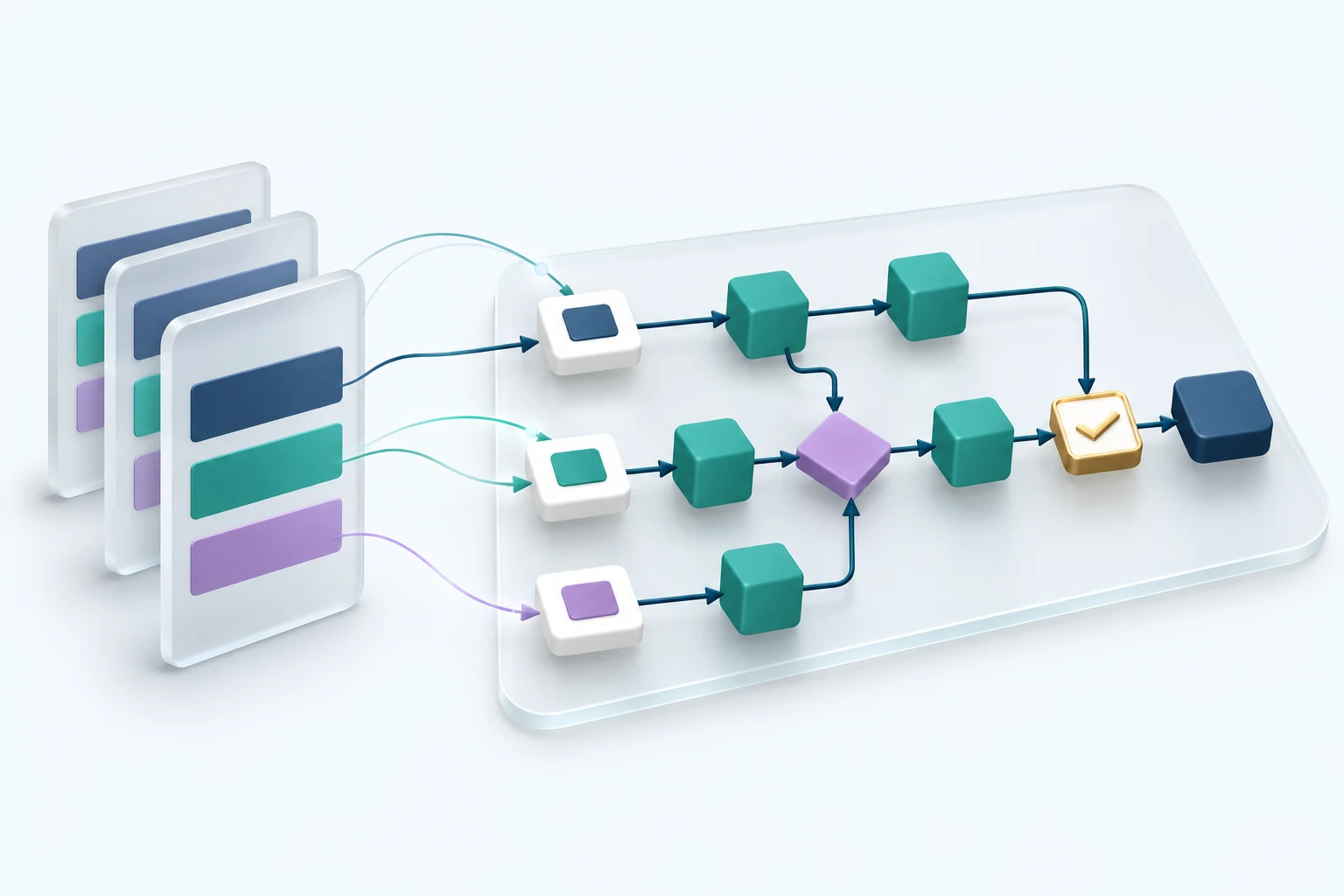
SkillZip opens skill packages into source-grounded section graphs. Recurring, contract-compatible routines become reusable macros; task-time retrieval exposes only the relevant executable context.
Read the summary
Large Language Models (LLMs) increasingly act as agents whose procedural knowledge is stored in reusable skill packages and loaded at inference time. As skill libraries grow, a central challenge is to expose the smallest sufficient executable context under a limited context budget. Existing systems struggle to reuse routines below the whole-skill level, preserve procedural contracts during compression, keep compressed routines executable and expandable, and update the compressed library as skills evolve. These challenges reveal a unit mismatch: skills are retrieved as packages, compressed as text, and converted into execution graphs only after retrieval, whereas reliable reuse requires a contract-bearing procedural unit. We propose SkillZip, an execution-aware procedural abstraction framework that performs contract-preserving compression over section-level graphs. SkillZip rewrites recurring contract-valid motifs into reversible ported macros while preserving boundary signatures, dependency closure, verifier reachability, and source-level expansion. At inference time, it hydrates a compact, dependency-closed context and expands macros only when required. ReZip further integrates new skills and revises risky macros using execution evidence. Comprehensive experiments on technical and embodied agent benchmarks show SkillZip consistently outperforms the strongest baseline by up to 12.2 points, while achieving a 3.46× compression ratio with 98.7% verifier reachability. Scaling analyses further confirm robust retrieval across skill libraries ranging from 200 to 100K skills.
From packages to
procedural memory.
One graph connects how skills are
represented, compressed,
and executed.
Make the procedure visible.
Split each skill into typed sections: inputs, operations, preconditions, verifiers, and outputs. Connect them through procedural dependencies while retaining pointers to the source.
The reusable unit is an executable section graph.
Compact context.
Stronger execution.
Evaluated on technical tasks and embodied agents,
with
consistent gains across comparable settings.
Episode success rate
Higher is better · %+12.2 points over SkillDAG on ALFWorld.
Reported main results · Paper, §5.1
Built for growing skill libraries.
Evaluated from 200 to 100K skills, with incremental updates through ReZip.
A small citation.
A big thank you.
If SkillZip is useful to your research,
please consider
citing our paper.
@article{tan2026skillzip,
  title   = {SkillZip: Contract-Preserving Graph
             Compression for Scalable Agent Skill Libraries},
  author  = {Tan, Xingyu and Wang, Xiaoyang and Liu, Qing
             and Xu, Xiwei and Yuan, Xin and Zhu, Liming
             and Zhang, Wenjie},
  journal = {arXiv preprint arXiv:2608.05604},
  year    = {2026},
  doi     = {10.48550/arXiv.2608.05604}
}